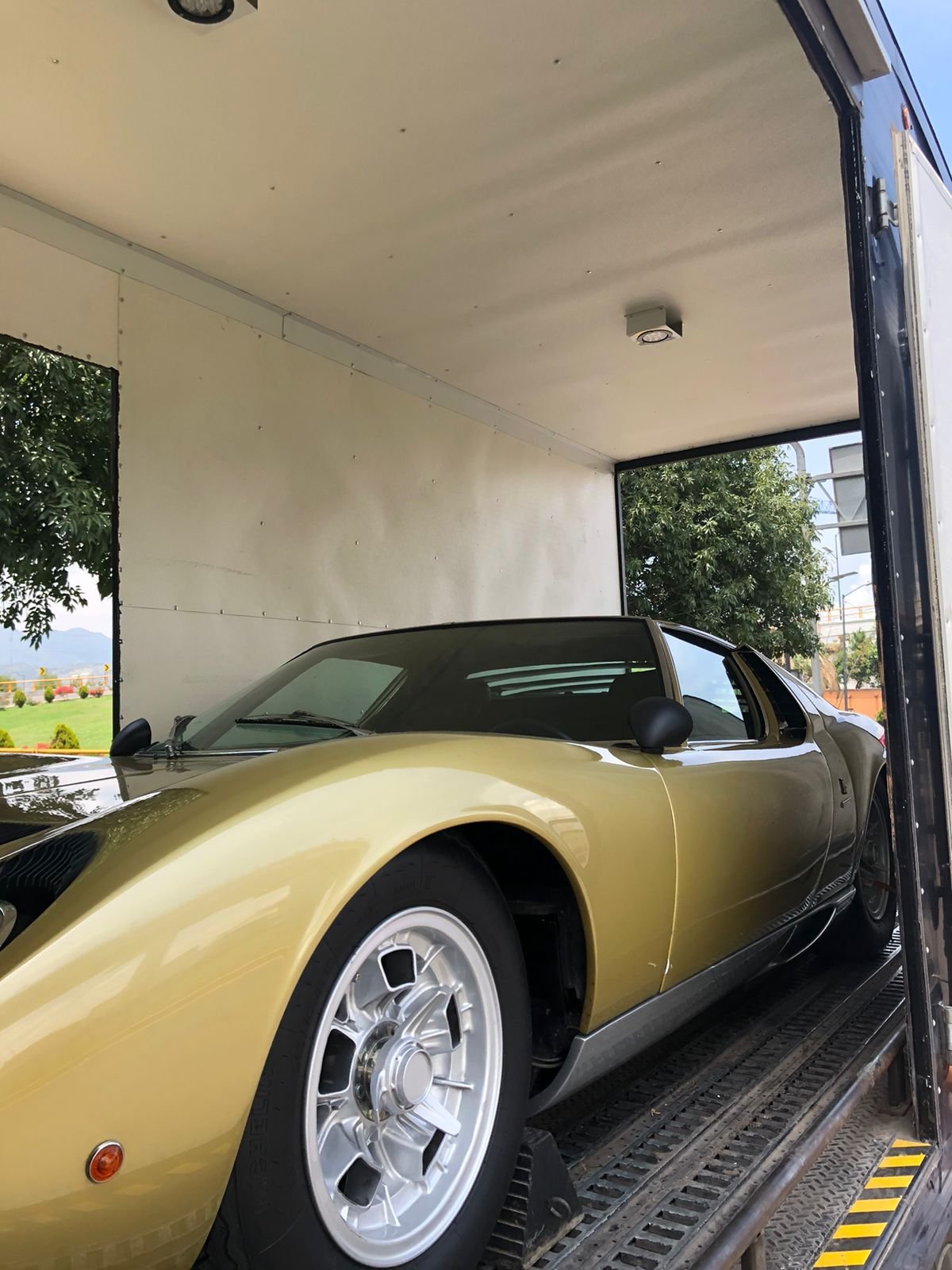

The Miura
The world's first true supercar
Some automobiles aren't simply vehicles — they're monuments. The 1970 Lamborghini Miura P400S falls squarely into that category. When we were trusted to coordinate its transport, we weren't moving a car. We were handling a sculpture that happens to have a V12 at its center.
Few cars in the history of the automobile have had the kind of cultural impact the Lamborghini Miura did when it debuted. Designed by Marcello Gandini and featuring the iconic transverse mid-mounted V12, the Miura didn't just look different — it felt different. It was the machine that effectively invented the template for what we now call the "supercar."
The car we transported was a 1970 P400S, chassis number #4440 — one of the later, most refined iterations of the model. With a 3,929cc V12 producing firework-level sound and a silhouette that still turns heads five decades later, this is a vehicle that represents the absolute peak of Italian automotive artistry.
When the client reached out, they didn't ask if we could handle it. They asked how we would. That's a question we love hearing, because it signals a level of understanding that this is not an everyday automobilia. From the moment we confirmed the dispatch, the vehicle was treated with the same care as a piece of fine art on its way to a museum.
1970
Model Year
V12
Engine Type
3,929
cc Displacement
#4440
Chassis
Transporting a Miura takes more than a trailer and a driver. It requires meticulous route planning to avoid rough roads, careful loading to preserve the low-slung bodywork, climate-controlled protection against the elements, and — perhaps most importantly — a crew that understands they are carrying one of the most significant automobiles ever built.
We don't say this to dramatize the work. We say it because it's true. When you move a car of this caliber, you are moving decades of automotive history in one singular body. The responsibility isn't a burden — it's a privilege. And it's exactly why, after ten years, cars like the Miura stay with us.
There are cars that are rare because very few were built. And then there are cars that become important because you can trace their story all the way back to the factory.
Chassis 4440 is one of those cars.
Built in 1970, this Lamborghini Miura P400 S is part of one of the most important chapters in the history of the automobile. The Miura wasn't simply another Lamborghini. It helped create the modern supercar.
Underneath the unmistakable Gandini-designed body was Lamborghini's legendary 3,929 cc V12. The engine was mounted transversely behind the cabin — a radical configuration for a production road car at the time.
The P400 S represented the second major evolution of the Miura. The original P400 had already shocked the automotive world. The S added more power and a series of improvements, including upgraded engine specifications, power windows and other refinements.
Lamborghini ultimately produced only 338 Miura P400 S examples, making the S substantially rarer than most modern performance cars.
But chassis 4440 has something even more interesting.
According to documented chassis research, 4440 was the 583rd Miura produced out of the approximately 762 Miuras built during the model's production run. Its bodyshell arrived from Bertone in December 1969 and the completed car left the Lamborghini factory in January 1970.
And then there's the color. Chassis 4440 was originally finished in Oro Metallizzato, a metallic gold.
The color wasn't simply an attractive choice. It was rare. Records indicate that only 21 Miuras originally received that particular color.
583rd
Miura Produced
338
P400 S Built
21
Oro Metallizzato
You're looking at a car that combines several layers of rarity — and, perhaps most importantly, the car has survived.
The completed Miura was delivered through the Italian dealer Carpanelli, with factory records identifying its original customer as Cudone of Padova. Later in its life, the car crossed the Atlantic and eventually surfaced in Arizona.
Like many important collector cars, it changed hands and its appearance changed over the years. But the identity underneath remained the same: Chassis 4440.
That number is what connects the car sitting in front of you today with the Lamborghini that came off the Sant'Agata assembly line more than half a century ago.
At some point in the car's remarkable journey, Top Auto Logistics became responsible for moving it. That's where our story intersects with Lamborghini history.
For a normal automobile shipment, the objective is simple: get the vehicle from one location to another. But with a car like chassis 4440, the vehicle isn't simply transportation. It is an artifact.
You cannot order another chassis 4440. You cannot reproduce the fact that this particular V12 passed through Lamborghini's factory in January 1970. You cannot manufacture another one of the 21 cars originally finished in that rare metallic-gold specification.
And according to the history provided to Top Auto Logistics, the car is now owned by Guillermo Marchand Lopez. That gives the story another chapter. The car that began its life in Italy more than 50 years ago continues to move through the hands of people who understand what it represents.
Today, there are faster Lamborghinis. There are more technologically advanced Lamborghinis. There are Lamborghinis that cost far more when new.
But the Miura remains one of the cars that changed everything. It proved that an exotic road car could be beautiful, mid-engined, brutally fast and dramatically different from anything else on the road. It helped establish the formula that would define generations of supercars.
And chassis 4440 is not simply an example of that history. It is a surviving piece of it.
For Top Auto Logistics, transporting a car like this is a privilege. Because when the vehicle you're moving is more than 50 years old, has a documented factory identity and represents one of the most important automobiles ever built, you aren't simply moving a Lamborghini.
You're moving history.
TOP AUTO LOGISTICS — 10 Years of Moving Cars That Matter.