
The JOTA
One of the rarest Lamborghinis in existence
When a client in California told us their Diablo JOTA SE30 needed to travel from Mexico City, we understood instantly what we were dealing with. This wasn't just any Lamborghini. This was a machine so exclusive that most enthusiasts have only seen it in photographs.
One of the Rarest Diablos Ever Built. One Extraordinary Journey.
Some cars turn heads. Others stop people in their tracks. The Lamborghini Diablo SE30 JOTA belongs to a very select category of automobiles that do both.
Created to celebrate Lamborghini's 30th anniversary, the Diablo SE30 was already an extraordinary machine. Lamborghini produced approximately 150 examples of this special edition, but the JOTA specification took the experience to another level. Only 28 JOTA upgrade kits were produced, with approximately 12–15 cars receiving the conversion at the factory, making these machines among the most exclusive and sought-after versions of the Diablo.
This was not simply a special-edition supercar. It was a road-going expression of Lamborghini's racing ambitions.
Beneath its unmistakable silhouette lived a naturally aspirated 5.7-liter V12, enhanced in JOTA specification to produce approximately 595 horsepower. The transformation included revised engine management, performance-focused mechanical upgrades, and a distinctive engine cover with raised air intakes designed to feed the engine. The result was a machine capable of reaching an astonishing reported top speed of approximately 211 mph.
The JOTA's aggressive engineering was matched by equally dramatic styling. Its purposeful details made it instantly recognizable to those who knew what they were looking at.
And then there was the color.
The SE30 introduced Lamborghini's distinctive Viola SE30, a metallic purple created for the anniversary model. Individual cars could also be ordered in special colors, making a particular example's original factory specification an important part of its identity.
For collectors, details like these matter. Production numbers tell part of the story, but a car's documented provenance, original specification, and individual history are what make it truly distinctive.
Transporting a car of this caliber across an international border is a responsibility that goes far beyond arranging a pickup and delivery.
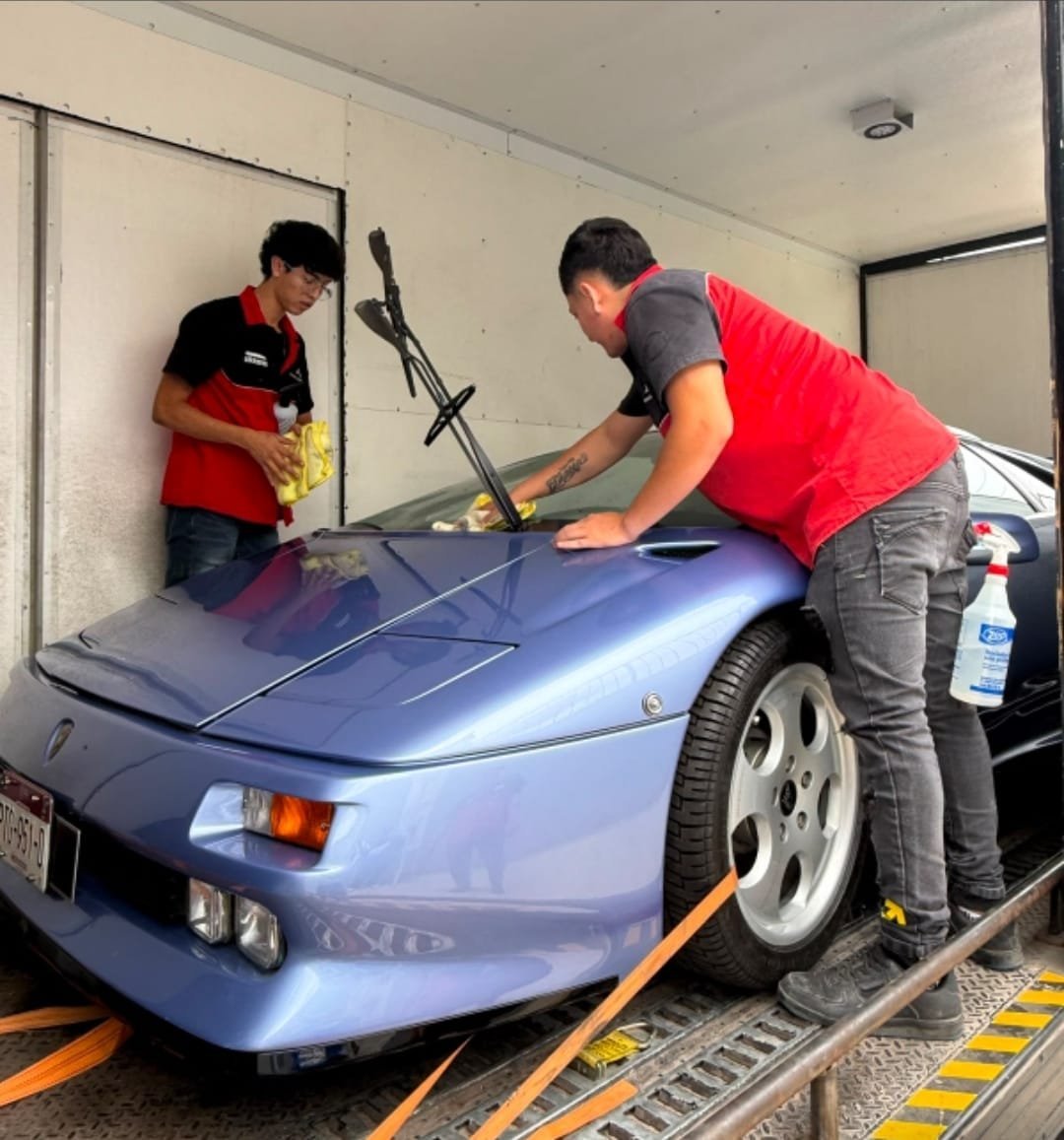
Top Auto Logistics coordinated the journey of this exceptional Lamborghini from Mexico City to California, bringing together international logistics, customs documentation, and specialized vehicle transportation.
Every stage required careful planning. Every detail mattered. With a vehicle this rare, the objective was clear: coordinate the journey, protect the car, and deliver it in the condition expected by its owner.
A Lamborghini Diablo SE30 JOTA is not an automobile that can be treated like an ordinary shipment. Its rarity, performance pedigree, and collector significance demand a level of attention that matches the machine itself.
There are certain details from a transport job that stay with you long after delivery.
On this one, we remember the orange protective strips we placed on the car. It was a small detail, but an important reminder that protecting a valuable vehicle often comes down to the little things done right.
When the owner opened the trailer doors and saw the Lamborghini exactly where it belonged, immaculate and ready for its next chapter, that was the payoff.
No dramatic presentation was necessary. No elaborate introduction was needed. The car spoke for itself.
As Top Auto Logistics celebrates ten years in the automotive transportation industry, this journey represents what makes our work meaningful.
We have helped customers move vehicles across cities, across states, and across international borders. Some shipments are about everyday transportation. Others involve automobiles that represent decades of engineering, history, and passion.
The Diablo SE30 JOTA was one of those special assignments: a rare Italian supercar traveling from Mexico City to California, entrusted to a team responsible for getting every detail right.
Because when a vehicle is this extraordinary, the journey deserves the same respect as the destination.
TOP AUTO LOGISTICS — Celebrating 10 Years of Moving Cars With a Story.
There are fast cars. There are exotic cars. And then there are cars that Lamborghini built because someone at the factory apparently decided: "Let's see how far we can take this."
The 1995 Lamborghini Diablo SE30 Jota was one of those cars.
The story begins with the Diablo SE30. Introduced in 1993 to celebrate Lamborghini's 30th anniversary, the SE30 wasn't created to be a comfortable grand-tourer. It was created to be lighter, more focused and closer to a racing car.
Only 150 Diablo SE30s were produced.
The cars shed weight by eliminating or simplifying equipment normally associated with a road-going Diablo. They received lightweight magnesium wheels, special bodywork, revised suspension and a more aggressively tuned version of Lamborghini's 5.7-liter V12.
The result was already an extraordinary machine. Then Lamborghini went further.
In 1995, Lamborghini Engineering developed the Jota kit for the SE30. The goal was simple: turn an already extreme road car into something much closer to a competition machine.
Only 28 Jota kits were produced. Of those, only about 12 to 15 were installed by Lamborghini at the factory, depending on how the individual car's history is categorized. The remaining kits were made available for installation elsewhere.
That distinction is incredibly important to collectors. A genuine factory-built SE30 Jota is not simply a Diablo with some aftermarket modifications. It is one of the rarest and most extreme factory-developed versions of the Diablo.
~595
Horsepower
639
Nm Torque
211
MPH Top Speed
The Jota transformed the character of the SE30. Lamborghini Engineering reworked the engine with changes including a lighter crankshaft, revised camshafts and ECU tuning. The intake system was modified and the exhaust was made less restrictive. Power climbed to roughly 595 horsepower, with torque around 639 Nm.
Then there was the part everyone noticed. Look behind the cabin. The Jota received a dramatically redesigned engine cover with two enormous air intakes rising above the roofline.
They weren't decoration. They were functional. They fed air into the modified intake system and gave the Jota a silhouette unlike virtually anything else on the road. The result was a Lamborghini that looked like it had escaped from a race paddock — and it was still wearing a license plate.
Period and auction documentation for factory Jota examples cites approximately 3.8 seconds from 0–60 mph and a top speed of approximately 211 mph.
Think about that for a moment. This was the mid-1990s. No hybrid assistance. No sophisticated modern traction systems. No computer-controlled everything.
Just a huge naturally aspirated V12, a manual gearbox, rear-wheel drive and an enormous amount of horsepower. The Jota was old-school Lamborghini at its most extreme.
The Jota wasn't merely a styling exercise. The SE30 program had been developed with motorsport ambitions, and Diablo Jota cars appeared in competition during the 1990s. Racing records document Diablo Jota entries in Japanese GT events beginning in 1995.
That competition DNA helps explain why the road-going Jota feels so different from an ordinary Diablo. It wasn't designed around the idea of making the owner comfortable. It was designed around speed.
This is where Lamborghini history becomes part of the Top Auto Logistics story. Top Auto Logistics had the opportunity to transport a 1995 Lamborghini Jota.
For a car like this, the responsibility is different. You're not moving a mass-produced automobile. You're handling a vehicle from a production run where the numbers are measured in dozens.
The difference between a normal Diablo, an SE30, an SE30 with a Jota kit and a genuine factory Jota can represent an enormous difference in historical significance and collector value. That's why provenance matters. Build records matter. Chassis numbers matter. And the story of each individual car matters.
When people look back at the great supercars of the 1990s, they remember the Ferrari F40, McLaren F1, Porsche Carrera GT prototypes and other legends. But the Diablo SE30 Jota belongs in that conversation.
It represents Lamborghini at a very unusual moment in its history — a period of corporate change, racing ambitions and engineering experimentation.
And unlike today's supercars, the Jota doesn't hide its personality behind electronics. You see the giant intake scoops. You hear the V12. You shift the gears yourself. You feel the weight — or lack of it — through the steering wheel.
It's raw. It's dramatic. It's excessive. It's Lamborghini. And Top Auto Logistics had the privilege of moving one.
28 kits. Roughly 12–15 factory-installed examples. One extraordinary Lamborghini.
TOP AUTO LOGISTICS — 10 Years of Moving Cars That Matter.