
The 328
A pre-war legend, still going strong
When you're asked to move a 1938 BMW 328, you don't look at the odometer. You look at the history books. This is a car that predates World War II — a machine designed for racing in an era before modern suspension, before crash safety, before any of the conveniences we now take for granted.
There are cars that are valuable. There are cars that are rare. And then there are cars that changed the automobile.
The 1938 BMW 328 belongs in that last category.
When BMW introduced the 328 in 1936, it wasn't trying to build another luxury automobile. It was building a sports car designed to prove what German engineering could accomplish on the world's toughest roads and racetracks.
And it worked.
Only 464 BMW 328s were produced between 1936 and 1940.
That means that when you see one today, you're not looking at an old BMW. You're looking at one of a very small number of survivors from a pivotal moment in automotive history.
The 328 arrived decades before the words "supercar" and "hypercar" became part of the automotive vocabulary. It didn't need them.
The car weighed roughly 1,830 pounds, and its 2.0-liter inline-six produced approximately 80 horsepower in road-going form. Those numbers don't sound extraordinary by today's standards. But that's exactly the point.
The 328 wasn't about having the biggest engine. It was about power, weight and engineering.
BMW used an advanced tubular space-frame chassis and independent front suspension. The result was a lightweight sports car with exceptional handling for its era. It was a machine built around the idea that winning wasn't necessarily about having the most horsepower. It was about being smarter.
The BMW 328 quickly established itself as a serious competition car. In 1936, an almost completely standard 328 won its class in the Eifelrennen at the Nürburgring.
The message was clear. BMW had built something special.
The 328 went on to compete successfully throughout Europe, including the legendary Mille Miglia. In the 1939 Mille Miglia, a streamlined BMW 328-based car won its class.
Then, in the 1940 Mille Miglia, BMW achieved one of the most remarkable results in the event's history. A BMW 328-based streamliner driven by Huschke von Hanstein and Walter Bäumer won the race outright.
Think about what that means. A small two-liter sports car had taken on some of Europe's most exotic and powerful machinery — and won one of the most prestigious road races in the world.
464
That's the production number. Only 464 BMW 328s were built.
Compare that with modern sports cars produced in the thousands, tens of thousands or more. The 328 was never intended to be common. It was an enthusiast's machine from the beginning.
And because these cars were used for competition, subjected to decades of changing ownership and lived through a world war, surviving examples became increasingly precious.
Every surviving car has a story. Some have racing histories. Some have been restored. Some have changed countries and owners. Some disappeared for decades before resurfacing.
There's another reason the 328 matters. It represents BMW before the company became the global automotive powerhouse we know today.
This was BMW establishing its identity through engineering and motorsport. The kidney grille was there. The inline-six was there. The focus on driving dynamics was there.
In many ways, the philosophy that defines BMW today can be traced back to cars like the 328. It was one of the earliest examples of the idea that a BMW should be designed around the driver.
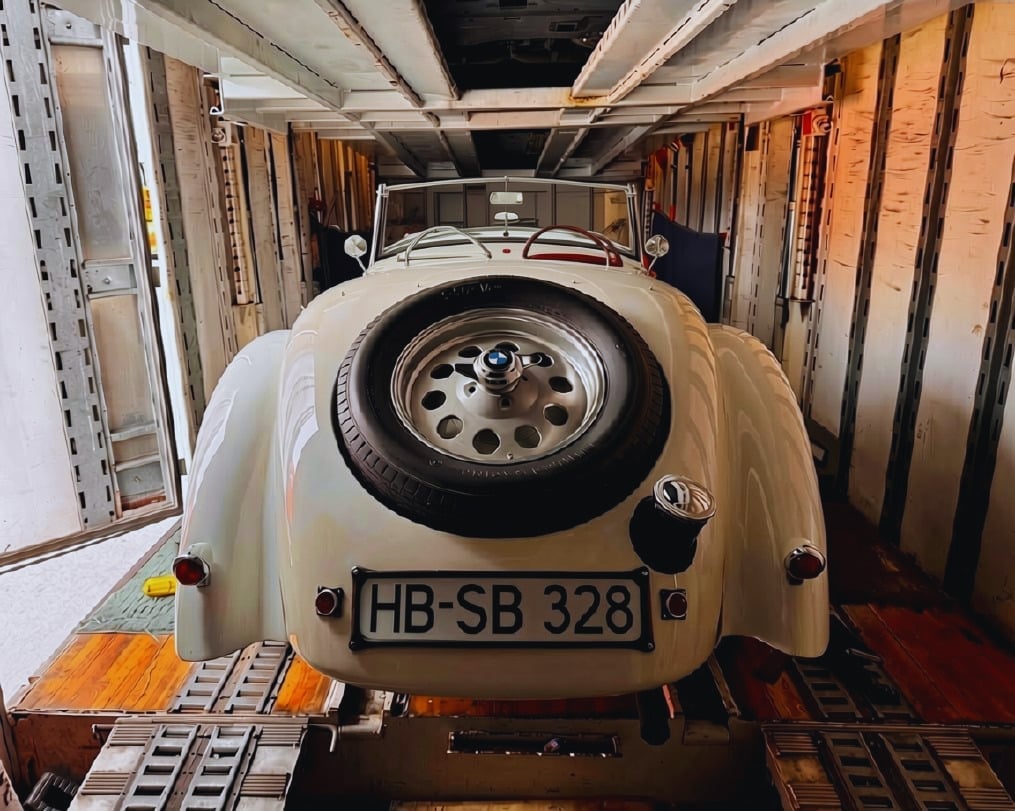
That's where the story becomes part of the Top Auto Logistics story. Nearly nine decades after this BMW was built, we had the privilege of transporting one.
For most people, moving an automobile means getting it from one address to another. For us, cars like this are different.
There is no replacement for a genuine 1938 BMW 328. If something happens to a modern automobile, another one can be built. But there will never be another original chassis from the 1930s carrying the same history.
You can't reproduce age. You can't recreate provenance. And you can't manufacture a car that was built nearly 90 years ago. You can only protect it.
The BMW 328 doesn't need a giant engine. It doesn't need a computer-controlled launch system. It doesn't need 1,000 horsepower.
It simply needs its history.
1938. BMW 328. 464 built. A car created before the modern sports-car world existed — and influential enough to help shape it.